| Origin | Descends from Kodokan Judo. Mitsuyo Maeda, a Kodokan-trained judo expert and prizefighter, arrived in Brazil in 1914 and taught the art to the Gracie family — most notably Carlos Gracie and his younger brother Hélio. |
|---|---|
| The Adaptation | Hélio Gracie, smaller and frailer than his brothers, modified the techniques to rely more on leverage and timing than on strength and explosiveness — the modification the whole art is built on. |
| The Defining Idea | The guard. In most wrestling traditions, being on your back means you are losing. In BJJ the bottom player wraps their legs around the opponent and attacks from there — sweeps, reversals, and submissions. That single idea reshaped modern grappling. |
| The Breakthrough | In 1993, Royce Gracie, not the biggest man in the tournament, won the first Ultimate Fighting Championship by submitting larger opponents on the ground. BJJ gyms spread worldwide. |
| Hallmarks | Position before submission — escape, improve, advance, then finish. There are no strikes in sport BJJ: the entire game is gripping, positioning, escaping, and finishing. |
| The Safety Culture | You tap early and you tap often, and your partner stops the instant you tap. Submissions are applied with control, never cranked — the mechanism that lets dangerous techniques be practiced at full resistance for a lifetime. |
| Belts | Five adult colors — white, blue, purple, brown, and black. Black belt sits at about a decade of consistent training, and the slowness is the point: a BJJ belt is widely trusted precisely because it cannot be bought or rushed. |
| Two Formats | Gi, where the jacket, collar, sleeves, and belt become grips; and no-gi, faster and slipperier, where control comes from underhooks, overhooks, and wrestling-style ties. Most schools teach both. |
The positional hierarchy, from back control with both hooks — the summit — down to having your back taken. Every decision on the mat is a move up or down this ladder.
White, blue, purple, brown, black — with up to four stripes between belts at the schools that use them.
Gi and no-gi. The same art at two paces: grip-dependent and methodical in the gi, faster and slipperier without it.
Warm-up, technique, positional sparring, then rolling — free sparring rounds, usually five to ten minutes each.
Brazilian Jiu-Jitsu: An Instructor's Overview
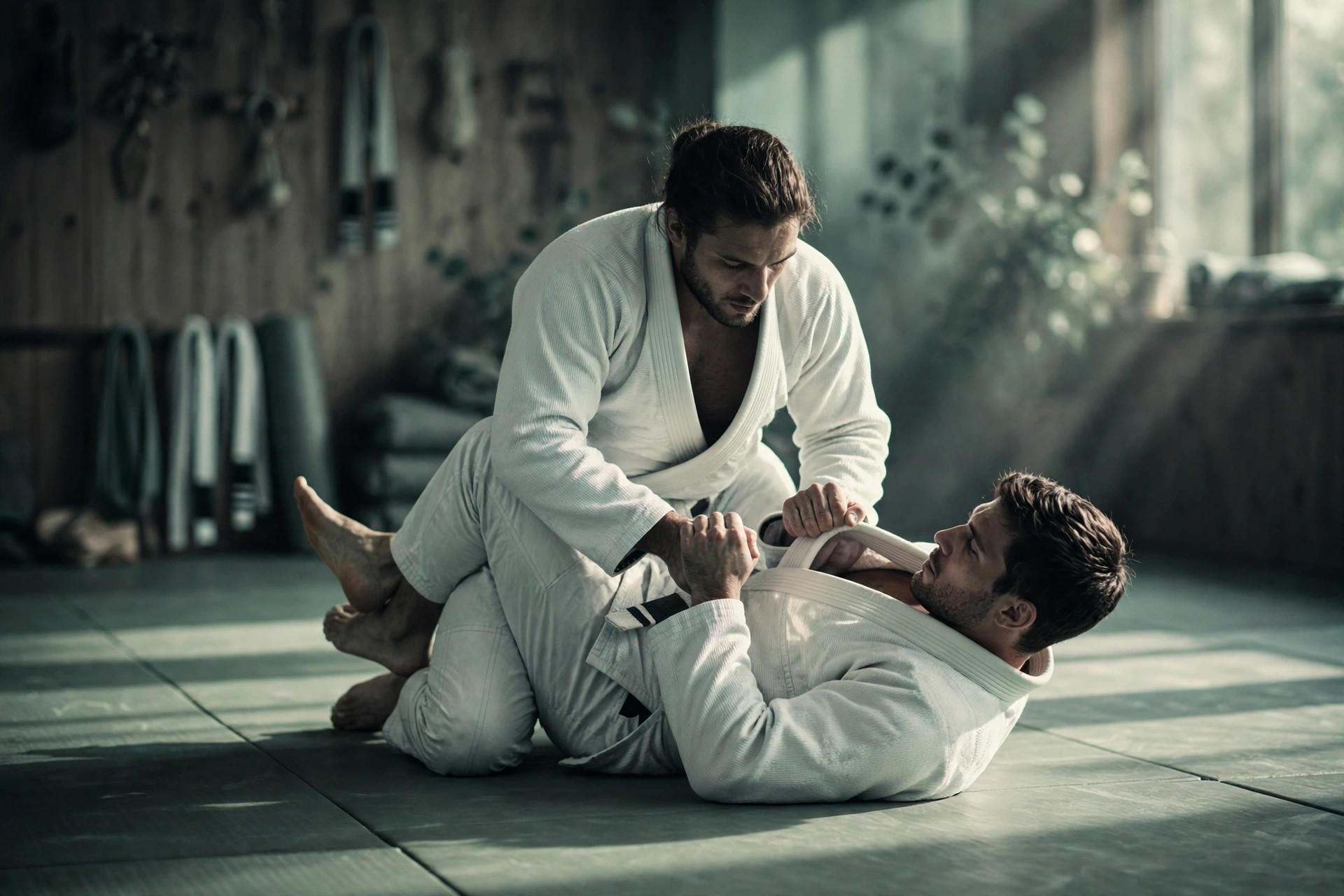
Second week of class. You're paired with a blue belt who weighs maybe 130 pounds, and within ten seconds you're flat on your back with his weight settled on your chest like a piece of furniture. You push. Nothing moves. You push harder, arms shaking, lungs burning, and he calmly slides a hand inside your collar. You tap to a choke you never saw coming, sit up gasping, and ask the question every beginner asks: how is that possible? The answer isn't strength, and it isn't a trick. It's a system. This guide is that system, explained whole.
Brazilian jiu-jitsu (BJJ) is a grappling art built on one simple observation: most fights that go to the ground are won by the person who understands position, leverage, and timing, not the person who is bigger or stronger. On the mat, a smaller practitioner routinely controls and submits a larger one, not through magic, but through mechanics. If you have ever watched a BJJ match and wondered how the person on the bottom could possibly be winning, this guide is your starting point.
- Brazilian Jiu-Jitsu: An Instructor's OverviewSecond week of class. You're paired with a blue belt who weighs maybe 130 pounds, and within ten seconds you're flat on…
- BJJ for Beginners: Your First 6 Months on the MatThirty seconds into your first roll, you're already in trouble. Your partner, friendly, smiling, half your age, steps a…
- Gi vs No-Gi: Which Should You Train?You signed the waiver, bought nothing yet, and the person at the front desk asks a question you weren't expecting: "Are…
- The Half Guard: BJJ's Working PositionThe pass was working. You cut through the open guard, felt the legs give way, and started to settle into side control.…
- Leg Locks at the Beginner Level: What Is Legal, What Is SafeIt happened the way it happens in every gym. You were rolling light, your partner's foot landed in your hands as he tur…
- Smashed: Getting Out From Under Side ControlThe pass lands and you feel the weight arrive. Their shoulder drives under your jaw and turns your face away. Their far…
- Your Guard Keeps Getting PassedIt happens the same way every round. Your partner stands up in your guard or grips your pants, your knees get pinned to…
- Gassing Out: Breathing, Pacing, and the Rounds You Throw AwayYou run. You lift. You played other sports without embarrassing yourself. Then one five-minute round of rolling leaves…
- Smaller: Training With Bigger, Stronger PartnersYou are the smallest person in the class, and the warm-up just ended. The instructor says find a partner, and the new h…
- The Plateau: Training Hard and Not ImprovingYou have trained three times a week for months. You drill what the class drills, you roll every round, you are not lazy…
- Stuck in Closed GuardHe closes his guard around your waist and the roll stops being jiu-jitsu and becomes an argument you are losing slowly.…
- Gone by the Drive Home: Why You Forget What You Were Just TaughtThe instructor shows the sweep twice, slowly, then at speed. You drill it twenty times with a partner who mostly lets y…
- Match Day Nerves: The First Tournament Problem Nobody DrillsYour training partners know your game, and your game works on them. Your guard passes get respected, your favorite swee…
- Training at Fifty Is a Different Sport (And It Is Still Jiu-Jitsu)Nobody's body files a formal resignation. It just starts sending memos. The shoulder that used to warm up in the first…
- BJJ Position Map & Beginner Reference
- BJJ First Six Months Survival Plan & Progress Tracker
- Gi vs No-Gi Decision Guide & Gear Checklist
- Half Guard Playbook
- Leg Lock Safety and Legality Map
- Side Control Escape Playbook
- Guard Retention Playbook
- Pacing and Conditioning Plan
- The Smaller Player's Playbook
- Plateau Diagnostic Workbook
- Closed Guard Passing Playbook
- The Retention System: A BJJ Training Notebook and Review System
- First Tournament Playbook: Six Weeks, One Small Game, and a Day That Runs on Rails
- Long Game Playbook: Training Jiu-Jitsu Past Forty, Fifty, and Beyond