| Origin | Korea. After liberation in 1945, the kwans — schools founded by men who had trained mostly in Japanese karate — taught their own blends under names like Tang Soo Do and Kong Soo Do. On April 11, 1955, a naming board settled on taekwondo as the unified name for the art. |
|---|---|
| The Name | Tae, to strike or break with the foot; kwon, the fist; do, the way. Kicks come first in the name and first in the training. |
| The Two Houses | The Kukkiwon/WT house: Kukkiwon, in Seoul, certifies black belt rank, and World Taekwondo's sparring, kyorugi, is the Olympic event; its forms are the Taegeuk poomsae. The ITF house: founded by General Choi Hong Hi in 1966, teaching his 24 tul, its sparring semi-contact and continuous, with punches to the head allowed. |
| Hallmarks | A kicking arsenal no other major art matches for depth: front, roundhouse, side, back, axe, hook, and spinning kicks, thrown standing, jumping, and in combination. Hands fill the forms and the basics — but the art's identity is the leg. |
| Headquarters | Kukkiwon opened in Seoul on November 30, 1972; it sets the technical curriculum and issues the dan certificates WT competition requires. World Taekwondo, founded May 28, 1973, writes the competition rules and holds the Olympic seat. |
| The World Stage | An Olympic demonstration sport at Seoul 1988 and Barcelona 1992, and a full medal sport since Sydney 2000. |
Basics, forms, sparring, breaking, and self-defense — taught by both houses, under different Korean names and with different weight.
Choi Hong Hi's forms library, performed with sine wave motion — the rising and falling hip movement he built into every technique.
Kukkiwon/WT and the ITF: two different arts that share a name, a country, and about twenty years of common history.
The Taegeuk poomsae of the WT house and the 24 tul of the ITF. Which library you learn tells you which house you are in.
Taekwondo: An Instructor's Overview
Two schools share the same strip mall. Through the first window you see students in V-neck uniforms kicking at an electronic chest protector that beeps when a foot lands hard enough. Through the second, students in wrap-front uniforms perform a pattern with no protector at all, and the instructor calls out the name Chon-Ji. Both signs say taekwondo. Both schools are telling the truth. They are also teaching two different arts that happen to share a name, a country, and about twenty years of common history. This overview maps the whole of taekwondo, both houses of it, so you can tell them apart and find your place in either one.
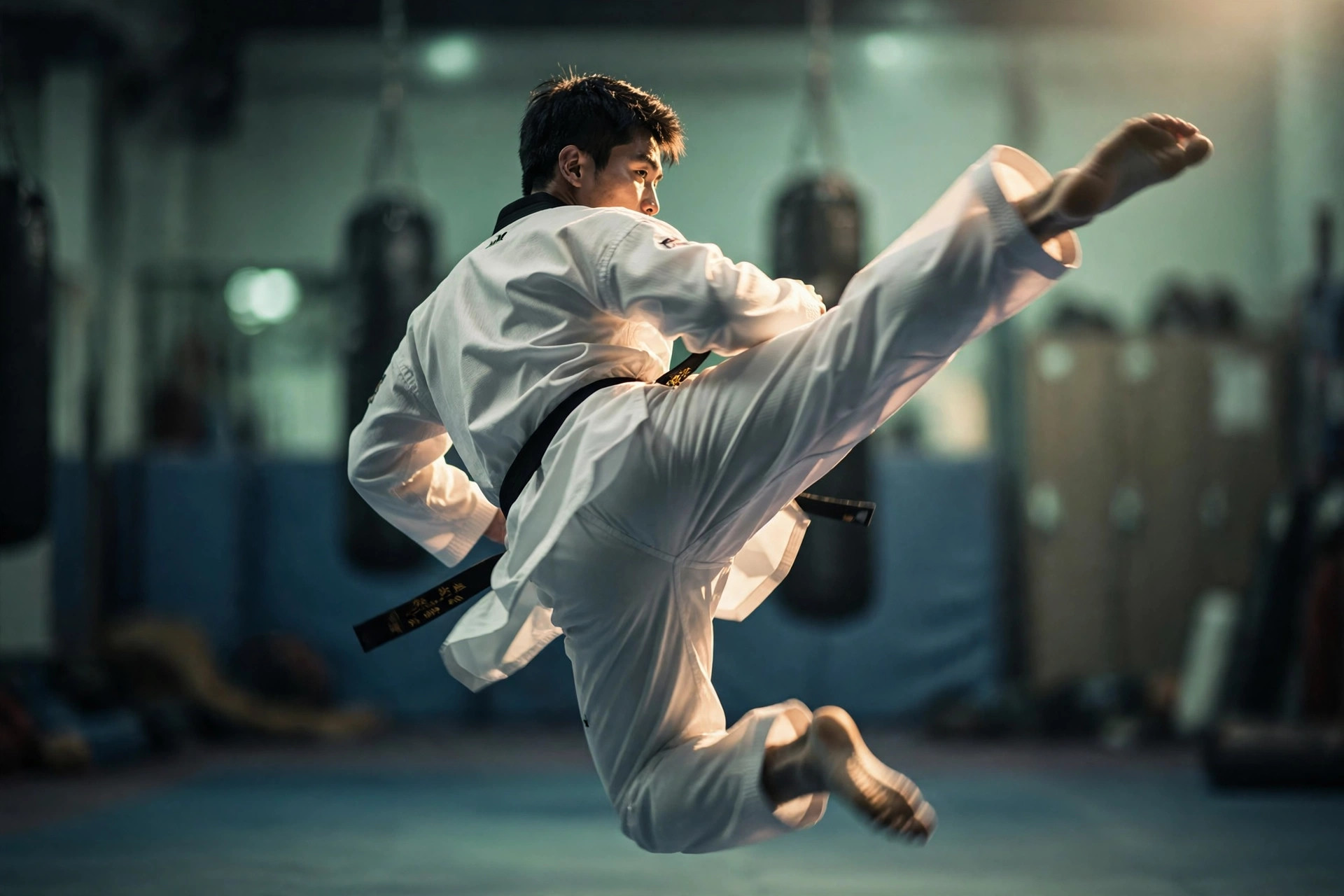
Taekwondo is a Korean striking art built around the kick. The name breaks into three parts: tae, to strike or break with the foot, kwon the fist, and do the way. Kicks come first in the name and first in the training. A developed taekwondo practitioner commands a kicking arsenal no other major art matches for depth: front, roundhouse, side, back, axe, hook, and spinning kicks, thrown standing, jumping, and in combination. Hands are not absent. Punches, knife-hand strikes, blocks, and elbow work fill the forms and the basics. But the art's identity is the leg.
- Taekwondo: An Instructor's OverviewTwo schools share the same strip mall. Through the first window you see students in V-neck uniforms kicking at an elect…
- Taekwondo: A Beginner's First Three MonthsFirst class. The borrowed dobok is stiff as cardboard and the belt will not stay tied. The instructor counts in Korean,…
- WT and ITF: The Two TaekwondosThe job moves you to a new city. You find a taekwondo school ten minutes from the house, walk in with your black belt i…
- Stuck at Chest Height: The Kick Height ProblemYou stretch every day. You can sit in a straddle on the floor and lean toward the mat, and by the tape measure your leg…
- Blanking on PoomsaeYou have performed this form two hundred times. You performed it last Tuesday without a thought in your head. Now your…
- No Power in the Side Kick and Turning KickIt is breaking day at the test, or just a heavy pad round in class, and your side kick arrives like a polite knock. The…
- Falling Out of Your KicksThe kick itself is fine. Standing in front of a mirror, in your own time, your roundhouse lands where you aimed it. The…
- Kicking at Air: The Sparring Distance ProblemWatch a beginner sparring round and count the kicks that land on nothing. The front leg comes up, falls a foot short, a…
- Your Board Did Not BreakIt is your turn. The holders set the board at the height the instructor called, your name goes quiet in the room, and y…
- Your Weak Leg Is Not Weak. It Is Untrained.Ask a taekwondo class to demonstrate a roundhouse with the lead leg and the room looks like a brochure. Ask for the sam…
- Taekwondo Quick Reference
- Taekwondo First Three Months Plan & Progress Tracker
- WT vs ITF Decision Guide
- Kick Height Mobility Plan
- Poomsae Memory and Test-Day System
- Power Kicks Mechanics Playbook
- Balance and Pivot Drill Book
- Sparring Range Playbook
- Breaking Manual: Materials, Techniques, Holders, and Exam-Day Standards
- Weak-Side Development System: Twelve Weeks to a Second Weapon